Taliesin (studio) page in March 2026 from https://en.wikipedia.org/wiki/Taliesin_(studio)

Published in Wikipedia

Reading Time: 5 minutes

I started this post to talk about my writing in Wikipedia, but while prepping this, I thought I’d show you things I’ve published that aren’t just here on my blog.

Last year, I mentioned in one of my posts that I was getting published in Madison magazine, with my piece on Mamah Borthwick‘s gravestone.

This link will bring you right to it.

And

The Frank Lloyd Wright Quarterly also published

two things

that I wrote while I worked at Taliesin Preservation:

“An Autobiography in Wood and Stone“, in 2018, which is a nice overview of Taliesin.

And

“Preserving Taliesin from the Ground Up” p. 22-27 in the Summer 2004 issue.

the editor didn’t tell us she was publishing it without a byline. Don’t worry, it’s been almost 18 years since it was published; I’m feeling a little better.

Then, SaveWright,

—the magazine from the Frank Lloyd Wright Building Conservancy—published two of my pieces:

“Landscape at Taliesin: Carrying on the Legacy,” in the Spring 2013 issue (vol. 4, Issue 1), Unity With Nature, p. 2-4

and

“Wright’s Own Kitchens at Taliesin”2 in the 2022 issue (vol. 13, no. 1), Wright on Kitchens, p. 2-5

Plus, my work appeared twice

on the Taliesin Preservation blog.

One piece that I wrote with their Communications Manager, Susan Kennedy, about Wright and Alex Jordan (the creator of the House on the Rock):

Taliesin, Frank Lloyd Wright’s House on the Brow of the Hill, and Alex Jordan’s Eclectic House on the Rock.

And they also published my post, “Wright called it the Water Garden“

that I first posted here.

Although, years ago I also worked on their website, along with another one we had just for the store.

it was a long time ago, when Flash animation still ran wild over the internets

Therefore, I had a lot of “learning by doing” experience in writing copy for items for sale in the giftshop;

Which meant a LOT OF ways to write about Wright’s Waterlilies and the Coonley Playhouse windows.2

The first time

I got paid for writing was in The American Midwest: An Interpretive Encyclopedia.

(Taliesin-related, of course)

It was a good deal – they gave me about $1 per word.

You can see the article by looking on Archive.org:

https://archive.org/details/americanmidwesti0000unse/page/672/mode/2up

MY WRITING about Taliesin

is on page 672.

If you only see a portion of the book when you click the link, you can set up an account there.
It’s cool – I search for books in it all the time to confirm page numbers or publishing information. Someone has to upload one to see it and you can “check” them out for an hour at a time.

So I just read my article in the Midwest Ency. after almost 20 years. While I would probably change some things, it’s not too bad.

BUT I WROTE IN WIKIPEDIA

before all that.3 

Obviously,

my first entry was about Taliesin.

The building not the half-god, jeeez

Wikipedia (hopefully for the foreseeable future) is a publication that is written, edited, and maintained mostly by volunteers.

In order to keep it going, they’ve got a strict set of rules.

I suppose you could break them all but in that case, they’d probably ban you.

IN FACT

I know someone who got banned.

But not because she was malicious. She was describing Wikipedia to her class, explaining that it can be changed by anyone, anywhere.

So,

to demonstrate this, she showed a page while under her own username and said something like, “don’t do THIS” then either deleted the text, or wrote something silly.

Even though she later reversed what she had done, they banned her.

I dunno if she ever got her account back.

And in 2017,

I added Wikipedia pages on all of the buildings on the Taliesin estate:

plus the Frank Lloyd Wright Visitor Center.

And, because of Wikipedia’s rules, I was careful to only work on the articles when I wasn’t getting paid.

So, guess what I did

in the first months of the Covid-19 pandemic?

—while everyone was trying to figure out what to do, or how to create sourdough starter —

No surprise: I went to the page on Wikipedia that has links to all of Wright’s buildings,

then clicked on each entry

and systematically corrected them.

I don’t mean that I went to the pages and said YOU’RE ALL WRONG!!~

No:

I corrected misspellings, found better hyperlinks, replaced the errant comma when the author meant to write a period… stuff like that.

And then,

I added the “Storrer number” on every entry.

“Storrer” is William Allin Storrer, Ph.D.

He wrote about all known Wright buildings and published catalogues and books on them starting in the early ’70s with The Architecture of Frank Lloyd Wright: A Complete Catalog.

Storrer’s work is like those catalogues of compositions by classical musicians, like the Köchel Catalogue and Mozart.

So, I put the Storrer number for each building in those Wikipedia posts, which is also on the big list of Wright buildings you start off at. It’s on each page under “Further reading“.

I confess, though

that I agree with those who don’t like the title I made for the Taliesin page on Wikipedia: Taliesin (studio)

Because the Taliesin structure isn’t just the studio.

I probably wrote that because it was the first thing that popped into my head while setting up the page.

But since the page has existed since 2004, changing it wouldn’t be that easy.

Besides, for the most part,

I’ve left all of those pages alone.

One of the things they tell “Wikipedians” is that you have to let changes happen. Like, don’t get into an electronic tit-for-tat with someone who has dared to make a change on “YOUR” page, find them and castigate them

in bold and ALL CAPS.

PLUS,

I know things about Taliesin and the other buildings on the estate that have not been published in outside sources.

So, unless someone else writes and publishes a fact I know,

I can’t put it into Wikipedia.

Because its rules are that you can’t post “original research”. So when I know something, I search for it in other writing. Otherwise, I sit on my hands. 

Well, Wikipedia doesn’t get to see my work, but you guys sure do!


Originally published March 24, 2026. 
The image at the top of this post is a screenshot from the Taliesin (studio) page on Wikipedia.


Notes:

  1. Here’s a partial list I wrote of the Coonley-Playhouse-window-design appearance, c. 2005:

On a t-shirt, an umbrella, a deck of cards (not including the special “Bridge Set”!), a wood screen that cost $220, a high-ball glass, cotton throw, table runner, placemats, a notepad, travel clock, nightlight, mug, a couple of scarves, a fricking WALL STENCIL, a $154.00-framed-tile, coasters, a set of children’s plateware, stitch kits, TWO different picture frames, cocktail napkins, a tumbler glass, sh–busloads of neckties (in tan, slate, and red – just this time around), a rollerball pen, giftwrap, a baseball cap, a pen holder….

  1. I received the offer to write the article after I’d mused to the Senior Director of Preservation and Collections at Fallingwater about the kitchen at Taliesin West. I think I’ll explore my ideas on that in another post. Later: on April 18, I published “The Kitchen at Taliesin West.
  2. and I know publishing in Wikipedia isn’t being accepted and peer-reviewed; but it’s still “Preservation by Distribution“. 
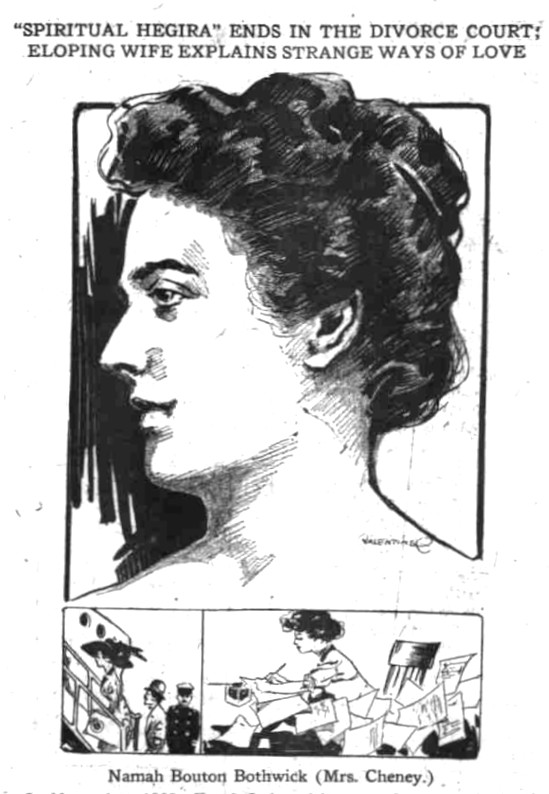
The Chicago Day Book December 21, 1911. In the public domain.

Was Mamah Borthwick the love of Frank Lloyd Wright’s life?

Reading Time: 5 minutes

Drawing of Mamah Borthwick.

People have asked me this question about Mamah

former wife of Edwin H. Cheney, and the woman for whom Wright first designed Taliesin south of Spring Green, Wisconsin. And who was murdered there with 6 others on August 15, 1914.

Since Mamah’s birthday is June 19, I am addressing this question in this post.1

Or “pondering” I guess. Since this is all my opinion. Did you ever think it wasn’t? Well, I didn’t, I can tell you that.

Plus, I’ve no idea what Wright would have thought or felt about this

even though I so wish that he was interested—beyond the grave—on my thoughts about things.

But, really:

was Mamah Borthwick the love of Wright’s life?

Determining who was “the love of” someone’s life is kind of like determining who someone’s “soulmate” is. Altho, dammit, the press continuously referred to Frank Lloyd Wright and Mamah as “soulmates”!

As for those two

I think they loved each other terribly. I’ll bet it was the out-of-your-mind crazy love. Of course, tempered by the fact that they were both married with children. Which came with a lot of excitement because they lived in Oak Park and everyone would know if they were fooling around.

And

if Wright had also been murdered at Taliesin in 1914, I think Mamah would have been counted as the love of his life. Which you can definitely say for her.

You can see that especially when you read the book that distant cousin Mark Borthwick published in 2023:

A Brave and Lovely Woman: Mamah Borthwick and Frank Lloyd Wright.

Mark Borthwick detailed how Edwin H. Cheney pursued Mamah for years. From what Mark Borthwick explored, it’s not certain that Mamah thought of ever marrying before becoming Mrs. Edwin H. Cheney in 1899.

Mark Borthwick wrote:

Apparently sober, constant, and determined, to judge by his years-long courtship of Borthwick, [Edwin Cheney] lacked the vivacious spark she herself nurtured…. Probably none of the men in her class measured up to her standard, but she no longer had the luxury of time.

A Brave and Lovely Woman: Mamah Borthwick and Frank Lloyd Wright, by Mark Borthwick (University of Wisconsin Press, Madison, 2023), 60.

In addition, when the press found Wright and Borthwick at Taliesin, Wright confessed that he and his then-wife Catherine were too young when they married.

Ok,

as for that choice: aside from the fact that everyone told them not to get married that young, Wright and Kitty were in love, it was the 1880s, and it’s not like they were the only people to ever do that. After all the phrase, “Marry in haste and repent in leisure” was put into writing almost 500 years ago.

So,

Wright married the first time in 1889 and Kitty gave birth to their first child in 1890 (Lloyd).

  • And their second in 1892 (John).
  • And again in 1894 (Catherine).
  • Then in 1895 (David).
  • Then a break and in 1898 (Frances).
  • And another break and their youngest in 1903 (Llewellyn).
    • Here’s part of what Wright in his Autobiography:

Architecture was my profession. Motherhood became hers.

Fair enough, but it was a division.

The young architect’s studio or workshop was within a few years built on Chicago Avenue. The young mother’s home and kindergarten had continued and still kept on—on Forest Avenue….

The handsome children were well born. They, each and all, were fine specimens of healthy childhood. They were curly-headed, blue-eyed, sunny-haired, fair-skinned like their beautiful mother. They all resembled her.

Every one of them was born, so it seemed, directly in his or her own right. You might think they had all willed it and decided it all themselves.

Frank Lloyd Wright, An Autobiography (Longmans, Green and Company, London, New York, Toronto, 1932), 109.

Then Wright and Mamah got close during the commission of her and Edwin’s house (commissioned in 1903).

So, MAN, Keiran

– you’re dancing around the answer here, aren’t you? Just say what you think: was Mamah the love of Wright’s life?

Here’s my two cents:

I don’t think so.

I don’t think it’s possible to say that someone was the love of a person’s life when they died just after your halfway-mark.

Wright met Mamah when he may have just been “going through the motions” in his marriage. Then they flee to Europe, which is followed by all the front-page news when they came back (which just bound them together I’m sure). And three years later, there was the horrible murder in 1914.

And then Wright lived over 44 years more. Therefore, he lived a lot of life after Mamah. I don’t think you can say that a man who continued to create incredible, deeply felt art, was emotionally stilted.

i mean, well yes, the man said and did some things sometimes where it’s like, hmmmm. but…

And I’m not saying Wright didn’t love Mamah. But I think we’re looking for the wrong thing if we point at her and say, “That was it. She was ‘The One.'”

In 1924, after his relationship with Miriam Noel (his second wife who I wrote about recently) rounded to its close, he met Olga Lazovich Milanoff.

Olgivanna was also with him through some extremely difficult times. There’s Taliesin’s second fire; the pursuit following the birth of their daughter, Iovanna; and the years in the latter 1920s with difficulties followed by the Great Depression. And she was with him and brought him to the last part of his life, and revival of his career.

Back to Mamah

As I grow older, I have come to understand that love and relationships are a lot more complicated. I mean, Romeo and Juliet is a great love story when you read it as a freshman in high school, but…

So I’ll end with what I wrote to myself in April 2005.

After the marriage of now-King Charles III to Camilia Parker Bowles (now Queen Camilla):

[Charles] loves a woman, Camilla. He joins the navy (1971-76) and Camilla marries someone else. He can’t ask her to get divorced: it’s the 1970s and he’s still required to find a virgin.

So he finds Diana Spencer. She’s a little unstable. They don’t fit…. and he’s still in love w/Camilla. Diana starts having lots of torrid affairs and vomiting and cutting herself.

I’m saying:

neither party in that marriage was entirely innocent.

 And then Diana died….

 If I were in his position and my ex-wife, “The People’s Princess” died, seriously, one of the first things I would have thought would have been, “Oh cr*p, now I can’t marry Camilla.”2

 Now, at least, he gets to marry her, which from what I’ve heard, is what he wanted 35 years ago.

 To me, in the end, this is actually a very romantic story, about 2 people who loved each other and now finally get to be together, formally, in the eyes of the world….

 They still hang out and do stuff. Presumably, they still make each other happy.

 That is one cool story, if you ask me.

And that’s what I’ll say. Mamah Borthwick was a love of Wright’s life.


First published June 14, 2023.
The image at the top of this post was published in the Chicago Day Book, December 21, 1911. It’s available at this link.3


Notes:

1. She was born in 1869.

2. Or “oh bloody hell,” because I’m Prince (now King) Charles and not a dirty commoner.

3. I changed my original image from the front page of the Ogden Standard, which was a story published after Taliesin’s 1914 fire/murders on September 5 (find it here). That’s because I learned that the woman in the photo on that page is not Mamah Borthwick. The photograph shows Catherine Wright, his wife at that time. Thanks to Allen Hazard for correcting me.